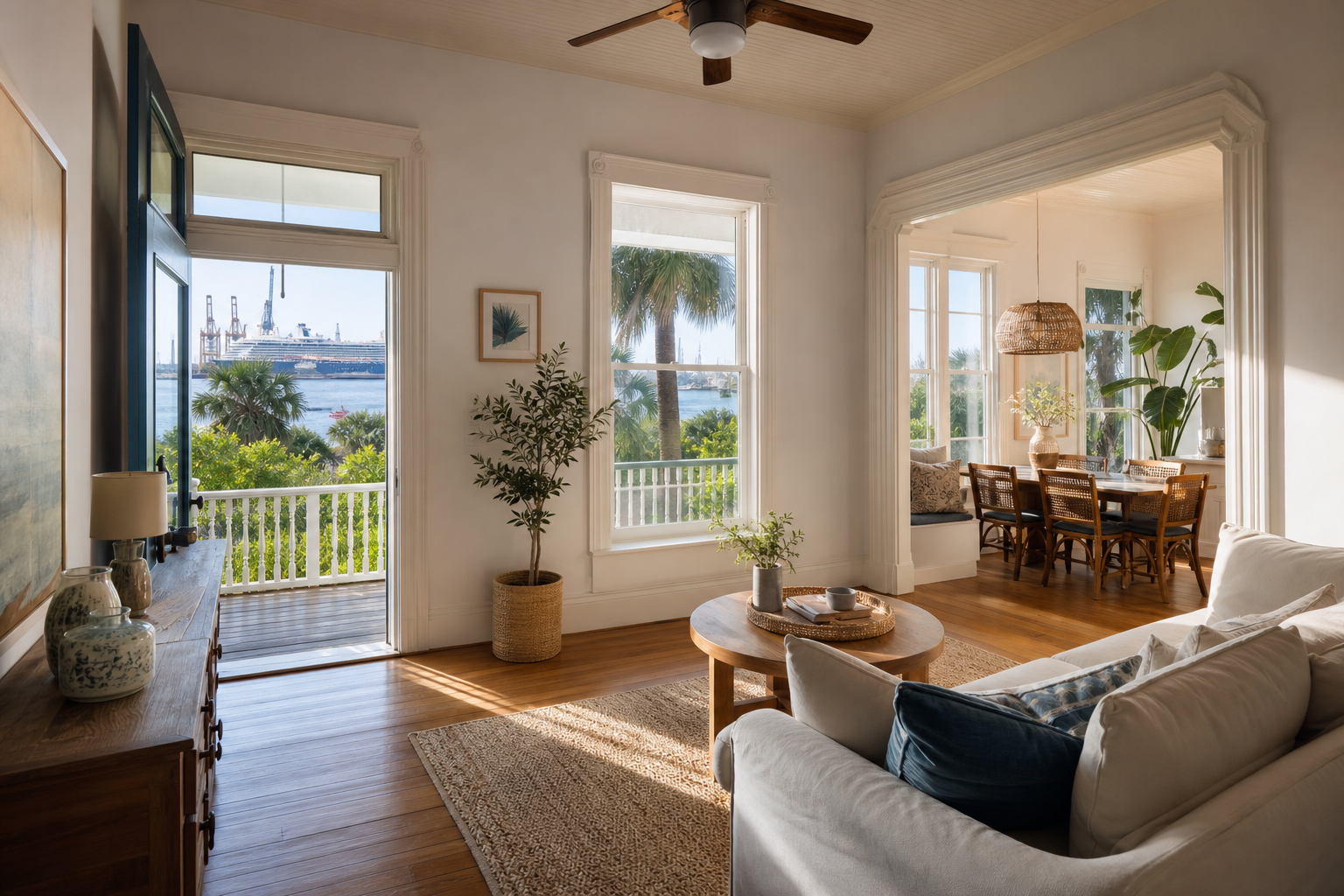
The Port of Galveston’s $2.4 billion master plan and $106 million West Port Cargo Complex expansion are driving demand for industrial, hospitality, and mixed-use real estate near the waterfront. Commercial property values in Galveston County rose sharply in 2025, and the near-term window through 2028 is drawing increased investor attention.
How is Galveston’s port expansion affecting local real estate in 2026?
The Port of Galveston is in the middle of more than $250 million in active waterfront investment, anchored by a $106 million West Port Cargo Complex expansion and a $2.4 billion, 20-year master plan approved in early 2026. The result is measurable upward pressure on commercial property values, growing demand for industrial and logistics space near the cargo piers, and a tourism-driven boost to hospitality and short-term rental demand near the cruise terminals, all of which are reshaping how investors and buyers think about Galveston real estate.
Key Takeaways
- The Port of Galveston’s $106 million West Port Cargo Complex expansion adds roughly 30 acres and a new 1,424-foot berth, with key phases completing in 2026.
- The $2.4 billion, 20-year master plan approved in March 2026 includes mixed-use commercial development along the waterfront, not just industrial expansion.
- Galveston County’s 2025 commercial reassessment showed overall commercial values up 18.1%, with retail up 40.1% and apartments up 31.5%, according to a Street Economics economic intelligence report.
- Cruise Terminal 16 is credited with adding over 1,000 jobs and $138 million per year in economic impact, cementing Galveston as the fourth-busiest cruise port in the U.S.
- Industrial and maritime-adjacent land within the port’s 840-acre footprint is limited and increasingly competitive, making repositioning of older port-proximate properties more attractive to investors.
What is the Port of Galveston actually building, and when does it finish?
This is the question I get most from investors who’ve heard about the port expansion but aren’t sure what’s real versus what’s still on paper. Here’s what’s confirmed and underway.
The West Port Cargo Complex expansion
The most tangible near-term project is the $106 million West Port Cargo Complex expansion, which covers Piers 30 through 41 on the west side of Galveston’s harbor. The project encloses and fills outdated slips, adds a new berth of roughly 1,424 feet, and increases cargo acreage by about 30 acres. The intent is to let the port handle approximately one-third more cargo than before, according to Connect CRE’s coverage of the expansion. Key phases are scheduled for completion between Q2 and Q4 2026.
That timeline matters for real estate. Industrial users looking to position near the expanded cargo complex are making decisions now, before the new capacity is fully online. That’s the window.
The $2.4 billion master plan
In March 2026, the Galveston Wharves Board approved a $2.4 billion, 20-year master plan that goes well beyond cargo. The plan calls for additional cruise terminals, expanded cargo facilities, and mixed-use commercial development along the waterfront. This isn’t purely industrial expansion, it explicitly includes commercial and mixed-use real estate components, which changes the calculus for investors who might otherwise write off port-adjacent land as purely working waterfront.
The port’s 2026 planning update also confirms construction began on the final phase of a 2-mile internal roadway between approximately 10th and 41st Streets, funded partly by a $9.3 million TxDOT grant. That road is designed to keep more port traffic inside the port footprint, which has real implications for neighborhoods near the port gates, and I’ll get to that.
Cruise growth and the fourth terminal
Galveston is already the fourth-busiest cruise port in the U.S. Cruise Terminal 16, recognized with a regional Landmark Award in April 2026, is credited with over 1,000 new jobs and $138 million per year in economic impact. A fourth cruise terminal, tied to an MSC Cruises agreement with Norwegian Cruise Line usage, was slated for around Q4 2025 under the port’s strategic master plan. That concentration of passenger traffic reinforces demand for hotels, short-term rentals, restaurants, and retail near the Strand Historic District and Seawall Boulevard.
How does port growth translate into real estate opportunity, and where?
Not all port-driven real estate opportunity looks the same. I find it useful to think about this in two distinct zones: the industrial and logistics corridor near West Port, and the tourism and lifestyle districts near the cruise terminals. The 2026 expansion affects both, but the strategies are different.
Industrial and logistics near West Port
The projected increase from roughly 3 million to more than 5 million tons of annual cargo over the next 5 to 10 years, per the port’s updated strategic master plan, directly supports demand for distribution centers, truck yards, and specialized storage along Harborside Drive and nearby corridors. These are the first-line beneficiaries of the cargo expansion.
The catch is that land near the port is already tight. Street Economics’ economic intelligence report on Galveston describes industrial and maritime-adjacent land within the port’s 840-acre footprint as limited and increasingly competitive, directly tied to the $250+ million infrastructure program underway. Demolition of the decommissioned grain elevator and the filling of outdated slips convert underutilized waterfront structures into active cargo acreage, which reduces the pool of “cheap” or underperforming waterfront land available for other uses. For investors, that scarcity points toward repositioning older industrial buildings, assembling parcels, or upgrading existing warehouses rather than finding raw land.
The near-term window here runs roughly 2026 through 2028, when the new cargo capacity comes online and industrial users are actively seeking aligned space. After that, the broader 20-year master plan creates longer-horizon opportunities, but those will emerge in phases as specific projects move from planning into construction.
Hospitality, short-term rentals, and mixed-use near the cruise terminals
Cruise growth tells a different story. The concentration of passenger traffic near Cruise Terminal 16 and the planned fourth terminal, both walkable or a short shuttle from downtown, is reinforcing demand for hotels, boutique accommodations, and short-term rentals targeting pre- and post-cruise stays. The Strand Historic District, downtown core, and Seawall Boulevard are the primary beneficiaries here.
The 2025 commercial reassessment data backs this up. According to the Street Economics report, Galveston County commercial property values rose 18.1% overall in the 2025 reassessment, with retail up 40.1% and apartments up 31.5%. These are assessed values, not transaction prices, they reflect perceived value and tax exposure, not necessarily what a property would sell for today. But a nearly 40% jump in retail assessed values is a signal that the market expects higher retail demand tied to port-driven tourism and workforce growth, particularly in walkable districts and waterfront mixed-use zones.
For anyone watching the short-term rental market in Galveston, I’d also point you to this deeper look at port expansion investment opportunities and the Galveston real estate market report from June 2026 for current transaction-level context.
Residential spillover and the traffic trade-off
Port expansion doesn’t affect residential real estate in a straight line. The economic activity, jobs, spending, tourism, creates upward pressure on housing demand near the port. But the 2-mile internal roadway project is also a sign that increased truck and cargo traffic is a real concern. The roadway is designed to keep more port flow inside the port footprint, which should reduce pressure on some city streets. Near port gates and truck connectors, though, buyers and tenants will weigh economic opportunity against noise and traffic.
I walk my clients through this trade-off honestly. A home near a major port entrance is a different proposition than a home in the East End Historic District or out on the West End, the neighborhood character is genuinely different, and the data I use to value a property has to reflect that. Every corridor near the port has its own dynamic, and the only way to get a clear picture is to look at actual comps and current activity in that specific area.
| Port Expansion Component | Investment/Scale | Timeline | Primary Real Estate Impact |
|---|---|---|---|
| West Port Cargo Complex expansion | $106 million, ~30 acres added | Q2–Q4 2026 completion | Industrial, logistics, warehouse demand near Harborside Drive |
| 20-year Galveston Wharves master plan | $2.4 billion total | 2026–mid-2040s (phased) | Mixed-use, commercial, and cruise-adjacent development |
| Cruise Terminal 16 | $138M/year economic impact, 1,000+ jobs | Operational; award April 2026 | Hospitality, STR, retail near Strand and Seawall |
| Fourth cruise terminal (MSC/Norwegian) | Part of master plan | Targeted Q4 2025 | Additional hospitality and tourism-oriented demand |
| Internal port roadway (10th–41st St.) | $9.3M TxDOT grant + port revenues | Construction began Q1 2026 | Improved port access; traffic implications for adjacent corridors |
Frequently Asked Questions
How is Galveston’s 2026 port expansion affecting property values near the waterfront and West Port Cargo Complex?
The expansion is contributing to upward pressure on commercial property values, with Galveston County’s 2025 reassessment showing commercial values up 18.1% overall, retail up 40.1%, and apartments up 31.5%, according to Street Economics. These are assessed values rather than transaction prices, but they reflect market expectations tied in part to the $250+ million in active waterfront investment. Industrial and maritime-adjacent land near the port is described as limited and increasingly competitive, which tends to support values for well-positioned properties in those corridors.
Is 2026 a good time to invest in industrial or warehouse space close to the Port of Galveston?
The near-term window looks favorable for investors focused on industrial and logistics space, with the West Port Cargo Complex expansion completing in 2026 and cargo volume targeted to grow from roughly 3 million to more than 5 million tons over the next 5 to 10 years. Land near the port is already tight, so the opportunity is more about repositioning existing buildings or upgrading warehouses than finding raw land. Your specific position depends on the property’s access to port gates, rail, and truck routes, that’s a conversation worth having with someone who knows these corridors.
Which Galveston neighborhoods or corridors are most likely to benefit from the new cruise terminals and cargo expansion?
The two zones benefit differently. Industrial and logistics properties along Harborside Drive and near the West Port piers (Piers 30–41) are the primary beneficiaries of cargo growth. For cruise-driven demand, the Strand Historic District, downtown core, and Seawall Boulevard are best positioned, Cruise Terminal 16 and the planned fourth terminal are walkable or a short shuttle from those areas, reinforcing demand for hospitality, retail, and short-term rentals. Residential areas near major port entrances and truck connectors face a trade-off between economic activity and traffic.
How does Cruise Terminal 16 and the planned fourth cruise terminal affect short-term rental demand in Galveston?
Cruise Terminal 16 alone is credited with over 1,000 jobs and $138 million per year in economic impact, and Galveston is now the fourth-busiest cruise port in the U.S. That level of passenger traffic creates consistent demand for pre- and post-cruise stays, which supports short-term rentals and boutique hotels near the terminals and tourist districts. A fourth terminal under the MSC Cruises agreement would concentrate even more passenger flow in those areas, which investors in vacation-oriented residential product near the Strand and Seawall are already factoring in.
Does Galveston’s limited port-adjacent land make redevelopment of older properties more attractive in 2026?
Yes, with industrial and maritime-adjacent land described as limited and increasingly competitive within the port’s 840-acre footprint, repositioning older industrial buildings and assembling parcels is becoming a more realistic path than finding undeveloped land. The demolition of the decommissioned grain elevator and the filling of outdated slips are converting underutilized waterfront structures into active cargo acreage, which further tightens the supply of alternative-use waterfront land. Investors willing to work through the complexity of older industrial buildings near the port have more options than those looking for a clean site.
The bottom line on Galveston’s port and real estate
The scale of what’s happening at the Port of Galveston, $106 million in cargo infrastructure completing this year, a $2.4 billion master plan reshaping the waterfront over the next two decades, and a cruise operation already generating $138 million annually in local economic impact, is not background noise. It’s a structural shift in how Galveston’s economy and real estate market are positioned.
Whether you’re watching the industrial corridor near West Port, the hospitality and short-term rental market near the cruise terminals, or the residential spillover in between, the opportunities are real and the timing is specific. I know this island and these corridors well, and I use data, not assumptions, to help clients figure out where they actually fit in this market.
If you want to talk through what port expansion means for a specific property or investment strategy, reach out and let’s run the numbers together.
Equal Housing Opportunity. Maddie Zimmerman is licensed in Texas. Texas Real Estate Commission: trec.texas.gov. This article is general information only and is not legal, tax, or financial advice. Confirm your own numbers with your title company, tax advisor, or lender.